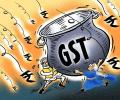
Continuing the upward trend, GST collections rose 10 per cent to about Rs 1.64 lakh crore in December compared to Rs 1.49 lakh crore in the same month a year ago. During the April-December 2023 period, gross Goods and Services Tax (GST) collection witnessed a robust 12 per cent growth, reaching Rs 14.97 lakh crore against Rs 13.40 lakh crore mopped up in the same period of the previous year, the finance ministry said in a statement on Monday. The average monthly gross GST collection of Rs 1.66 lakh crore in the first nine-month period this year represents a 12 per cent increase compared to the Rs 1.49 lakh crore average recorded in the corresponding period of FY23, it added.

The new tax is expected to subsume various indirect taxes, including excise and value-added tax.

For every rupee in the government coffer, 58 paise will come from direct and indirect taxes, 34 paise from borrowings and other liabilities, six paise from non-tax revenue like disinvestment and two paise from non-debt capital receipts, according to the Budget documents for 2023-24.

'Banks make money because they take the right credit calls. So they need to focus on risk mitigation rather than risk avoidance.'

The indirect tax reform Goods and Services Tax is stuck in the Rajya Sabha.

Mauritius-based Hinduja group firm IndusInd International Holdings (IIHL) has informed the administrator of Reliance Capital that it is ready with its equity contribution of Rs 2,750 crore in cash to acquire the bankrupt firm, but it wants certain conditions to be met in accordance with the resolution plan before transferring the amount. IIHL has also filed an application with the Mumbai Bench of the National Company Law Tribunal (NCLT), seeking directions for the administrator and the committee of creditors (CoC) to complete all pending activities to close the transaction and not let the lenders invoke the bank guarantees provided by the firm earlier.

Sector seeks declared goods status for ATF and withdrawal of service tax on first class and business class air tickets.
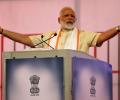
Modi said the Goods and Services Tax has within one year of its launch led to over 70 per cent jump in indirect taxpayer base, demolished check-posts and merged 17 taxes and 23 cesses into one single tax.

'Maharashtra is virtually in a debt trap.'

Stocks to watch: BHEL, L&T, IRB Infra and Suzlon
The change in the peak rate will not alter the 4-slab rate structure of 5, 12, 18 and 28 per cent agreed upon last year, but is only a provision being built into the model law to take care of contingencies in future, two officials in the know told PTI.

Global rating agency Moody's on Monday raised India's growth forecast for 2024 calendar year to 6.8 per cent, from 6.1 per cent estimated earlier, on the back of 'stronger-than-expected' economic data of 2023 and fading global economic headwinds. India's real GDP expanded 8.4 per cent year-over-year in the fourth quarter of calendar year 2023, resulting in a 7.7 per cent growth for full-year 2023. Capital spending by the government and strong manufacturing activity have meaningfully contributed to the robust growth outcomes in 2023, Moody's Investors Service said.
GST collections rose 12 per cent to over Rs 1.49 lakh crore in February, the finance ministry said on Wednesday. February 2023 witnessed the highest cess collection of Rs 11,931 crore since implementation of GST. The collections are, however, lower than the second highest Goods and Services Tax (GST) mop-up recorded in January at over Rs 1.57 lakh crore.

The liquidity in the banking system moved into surplus almost after three months as the Reserve Bank of India (RBI) absorbed over Rs 40,000 crore from the market on Monday, predominantly on the back of increased government spending. However, this situation may be short-lived given the higher demand for funds to pay taxes and year-end targets, treasury executives said. Meanwhile, two variable reverse repo rate (VRRR) auctions held on Tuesday received weak response.

If you are being over-charged, bring it to the notice of the staff and, if required, the tax authorities.

"At present, there are two main rate slabs under which sa majority of goods are covered -- five per cent and 12.5 per cent -- which will now increase to three (five per cent, 12 per cent and 18 per cent).Will this result in multiple litigations is anybody's guess."
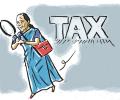
'Appellants may not lap up the scheme because, first, to do so would amount to admission of guilt, and second, they may have smelled victory before higher appellate forums,' notes S Murlidharan.

FM proposed rationalisation of various tax exemptions.

The government was close to imposing presumptive tax and the goods and services tax on the gems and jewellery sector

Once we break free of the idea that land is scarce, real estate is just a pile of bricks, steel, and glass. Any price surge will kick off a supply response, which kills off the possibility of sustained price appreciation, points out Ajay Shah.

Revenue buoyancy of GST will be key to improve the resource position of both central and state governments.
.jpg)
After setting up a committee under N Rangachary last year to look at taxation issues regarding the sector, the government has issued several notifications in the last eight months.

The Budget should use the extra RBI surplus to better effect, suggests A K Bhattacharya.

'We are not opposed to any Indian language. We are against Hindi imposition.'

With the reality of coalition politics staring the BJP in its face, this was inevitable, points out Ramesh Menon.

Justice Sanjiv Khanna, who headed the bench which heard Kejriwal's petition against his arrest in the case, said, "We will pronounce the interim order (on interim bail) on Friday. The main matter related to the challenge to arrest will also be taken on the same day."

Reliance Industries Ltd on Thursday reported a 7.4 per cent rise in its December quarter net profit, as its retail business rebounded and telecom earnings rose. Its consolidated net profit of Rs 18,540 crore, or Rs 13.70 per share, in October-December - the third quarter of April 2024 to March 2025 fiscal (FY25) - compared to Rs 17,265 crore, or Rs 12.76 a share, in the same period a year back, according to a stock exchange filing by the company.

Post-election capital expenditure (capex) has been weak at 2 per cent year-on-year (Y-o-Y) in M9FY25. The FY25 revised estimates (RE) indicate 7 per cent growth in FY25 against FY24, implying 21 per cent Y-o-Y growth in Q4FY25 government capex.

'Compare the new slabs with the previous years to understand if your tax liability will increase or decrease after the Budget.'

The Council also discussed process to make return filing simpler with just one return to be filed every month.

The immediate revenue loss could worsen the Centre's fiscal deficit, from the budgeted 3.3 per cent of gross domestic product (GDP) to 3.7 per cent of GDP -- a massive 40-basis-point increase. It was stabilised at 3.4 per cent since 2016-17, report Abhishek Waghmare and Dilasha Seth.

'Binary fission will happen -- startups will lead to more startups.'

The business would also not be allowed to claim any un-availed input tax credit for "goods lost" or "destroyed".

'Banks may find small ticket size lending economically unviable due to the cost of branch operations.'

According to reports, eight hours have been allocated by the speaker for discussion on the tax reform bill.

The panel suggested inclusion of alcohol and petroleum products in GST, as is being demanded by the Congress.

The government on Friday said GST will not be applicable on residential units if they are rented out to private persons for personal use. The government dismissed media reports which claimed that there is an 18 per cent Goods and Services Tax (GST) on house rent paid by tenants. In a tweet, the government said GST would be levied only when the residential unit is rented out to a business entity.
GST revenues rose by 11 per cent to about Rs 1.46 lakh crore in November over the year-ago period, the Finance Ministry said on Thursday. This is the ninth straight month when collections from Goods and Services Tax (GST) has remained above Rs 1.40 lakh crore. The gross GST revenue collected in the month of November 2022 is Rs 1,45,867 crore of which Central GST is Rs 25,681 crore, State GST is Rs 32,651 crore, Integrated GST is Rs 77,103 crore (including Rs 38,635 crore collected on import of goods) and cess is Rs 10,433 crore (including Rs 817 crore collected on import of goods).

The income tax department on Monday released rules for equalisation levy - a tax on online advertisements that would come into effect from June 1.
